INFINITE SPONGE POLYHEDRAL SURFACES
THE ART OF UNIFORM HYPERBOLIC SPONGE POLYHEDRAL SURFACES
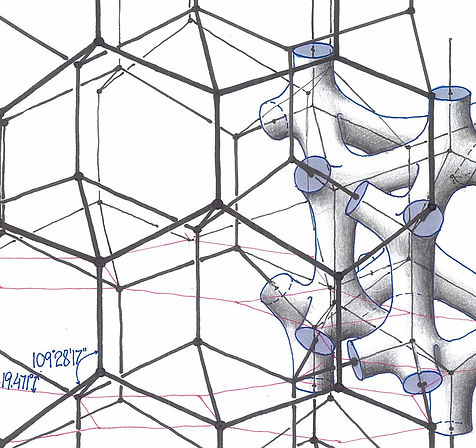
INFINITE SPONGE POLYHEDRAL SURFACES is a fascinating morphological exploration. it expresses the poetical beauty of enveloping surfaces over 3D geometrical networks having a striking similarity to nature’s microstructures representing superior structural form evolution millions of years in the process.
It can be clearly demonstrated that sponge surfaces take the shape of the most efficient forces distribution which manifests as a result great structural strengh out of minimal matter.
it is a passion about tomorrow's vision for architectural landscapes as a 3D environment that might have the looks of elaborate free forms but is, in fact, the most ordered repetitive modular space, geometrically speaking.
sponge polyhedral surfaces divide the space by enveloping polygonal 3D networks, most of which until recently were present mainly in the extensive research carried out over a period of five decades by Professor Emeritus Michael Burt, a renowned pioneer in the field of morphology and the receiver of the prestigious 2016 Cosmic Fishing Award by Thomas T. K Zung of Buckminster Fuller, Sadao & Zung Architects at the RISD in Providence.
Sponge polyhedra structures exist in nature and evolved over millions of years to withstand extreme conditions, their shape, and morphology, as observed in microorganisms and bone structures, are nothing like structures designed by humans. their seamless and continuous jointless structure can appeal both artistically and architecturally to a wide range of design related professions from jewelry to new frontiers in megastructure projects.
the challenge in modeling computer generated sponge surfaces is in defining their genetic core units which make the manufacturing of everyday products or large scale structural elements imaginable and even possible.